Locating tools
Radio Detection transmitters & receivers (Radio Scanner)
The radio scanner is the tool most frequently used for single utility locating. Essentially, a wand that you wave over the ground capable of detecting a current emitted from live loaded conduits (120v & above). If there is not a naturally occurring current, we are able to clamp on to an aboveground portion of the service & energise it with a signal that we can trace. Basically, the radio scanner can find anything with continuity making it possible to locate:
- Buried services (hydro, water, gas).
- Ground faults on buried conductors (including tracer wire breaks).
- Determining the exact location of a camera that is in a conduit/pipe underground.
Traceable signals
Duct Rodders
Not every buried service naturally emits a traceable signal. Some services that do not emit signals are made of material that will not carry a signal, making it impossible to send a traceable signal form an aboveground portion of the service. A Duct Rodder is a rod that gets pushed into non-conductive pipe so that they can be traced from ground level, making it possible to locate:
- Plastic sewer
- Plastic storm drains
- Plastic conduits
Off Road GPR
Noggin 250
The same as regular GPR, however the Noggin 250 is on a cart with larger wheels and is made for outdoor use. In addition to locating all the same services the GPR can locate, the outdoor capabilities allow us to locate:
- Buried tanks.
- Buried obstructions.
- Ground faults in outdoor subgrade conduits.
GPR
Ground-penetrating radar (GPR) can be utilized to assist in locating objects in both the surface & the sub surface. High-frequency radio waves are directed into the surface & sub surface. When reflected to the device, the signals create raw data that a trained technician interprets to ascertain information about the following:
The surface:
- The thickness of the concrete surface.
- The pattern & spacing of reinforcing rebar.
- The location of tension cables.
The sub-surface:
- Buried services (water, sewer, hydro etc.)
- Buried objects (tanks, tile beds, etc.)
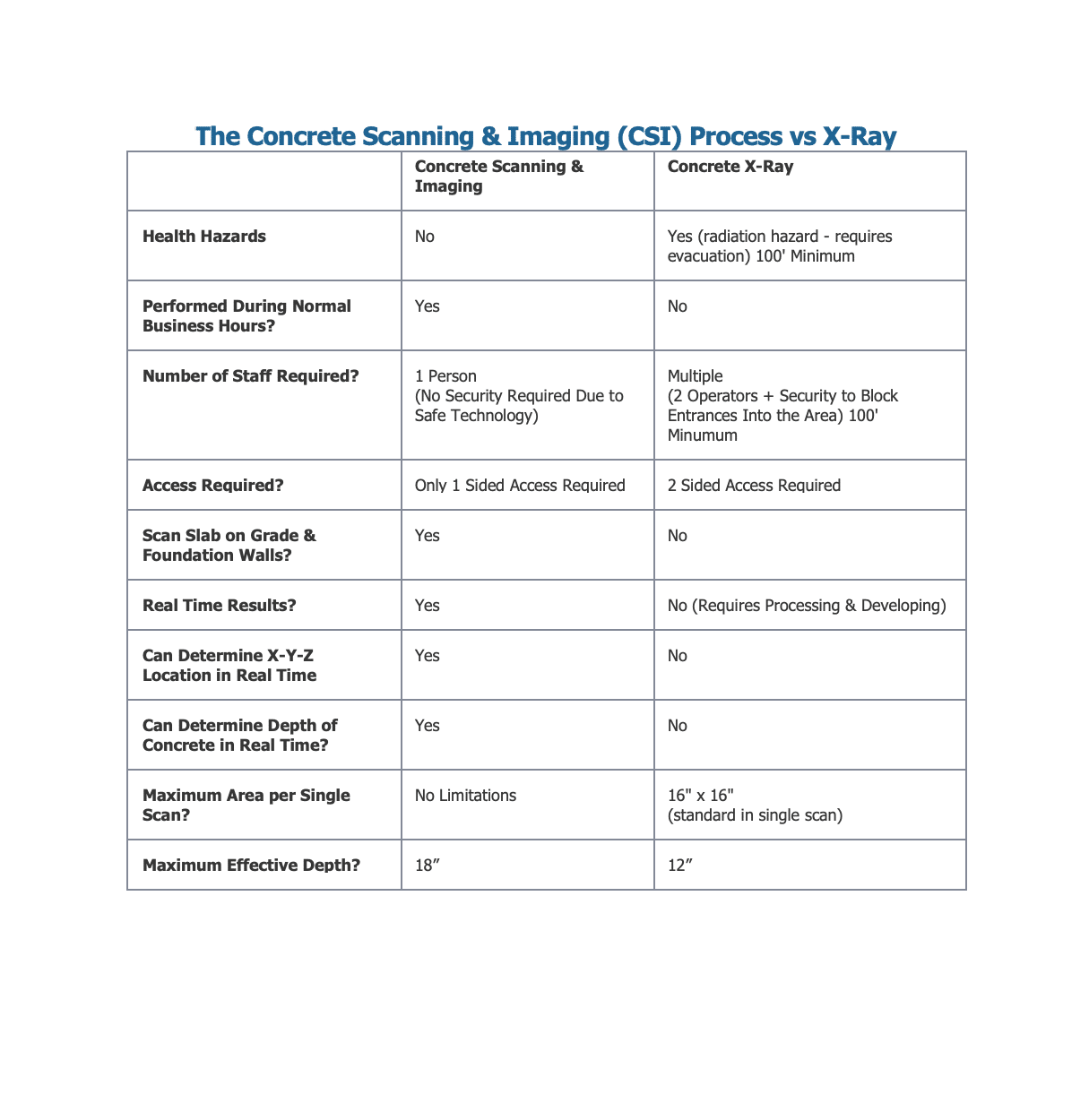
The GPR is the most frequently used tool where x-ray used to be used. GPR has not completely replaced x-ray, however it has several advantages (hyperlink to comparison) over the x-ray that are quickly making it a more frequently used tool.
Infrared Camera
The infrared camera is a tool that is capable of visually seeing differences in temperatures. This makes it possible to find:
- In-floor heating lines (and determine where they are working & where they are not).
- Cold zones.

Trusted Locating Services
What Makes Us Different
Local Technicians
Proven Equipment
Certified Specialists
Integrated Services
Our Service Coverage
Our concrete scanning services are available throughout
For large-scale or specialized projects, our crews can mobilize anywhere in Ontario.
- Cambridge
- Kitchener-Waterloo
- Guelph
- London
- Hamilton
- Toronto (GTA)