
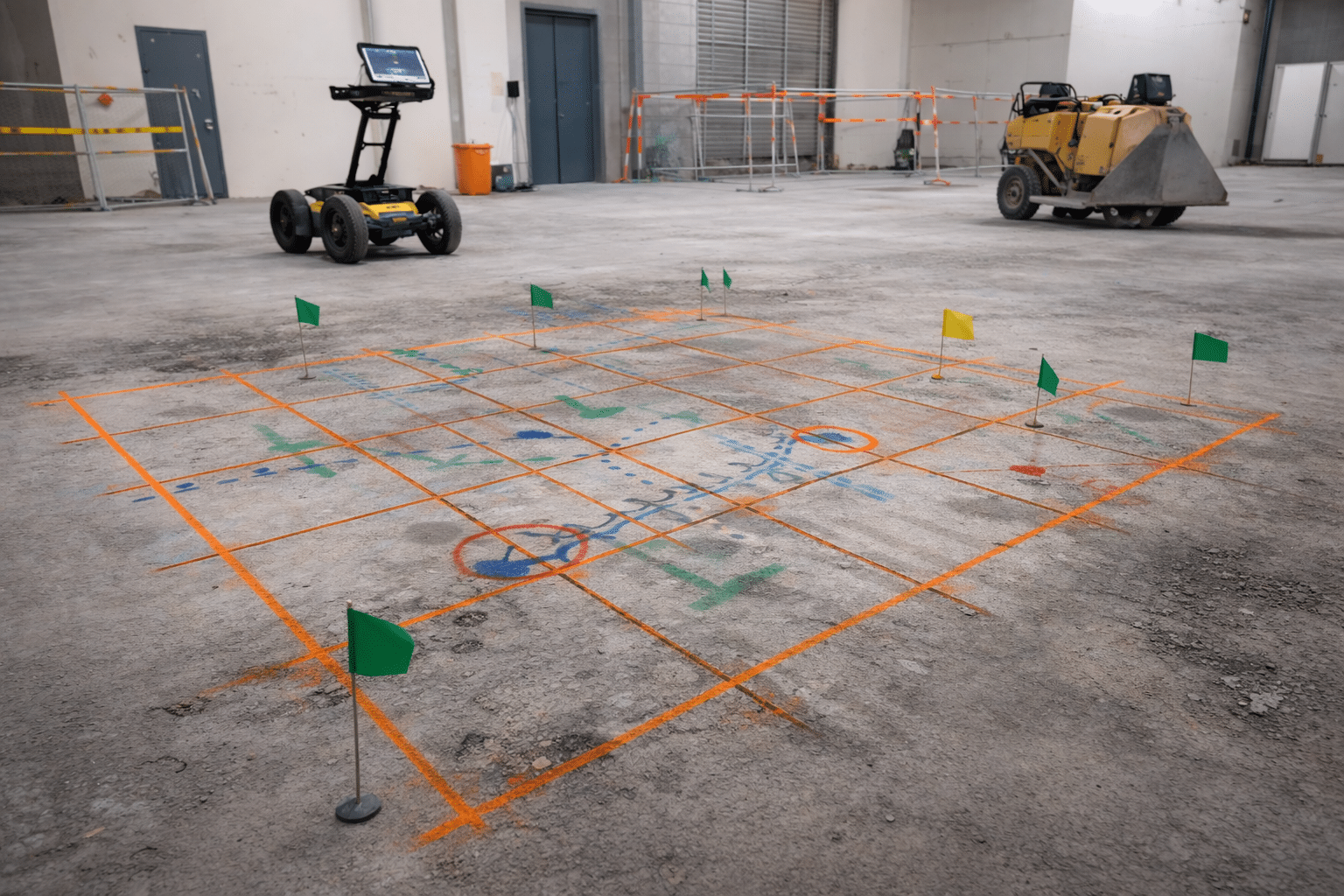
London contractors often assume that once they are inside a building, the risk of unknown utilities is lower. In reality, commercial slabs can hide just as much infrastructure as exterior excavation zones.
Private utility lines are one of the most common issues discovered during slab work. These systems are not always documented, and they rarely appear in standard locate requests. That is why many crews now plan for private utility locating services before starting any slab cutting or modification work.
The slab work scenario London contractors recognize
A typical project involves commercial slab construction updates or tenant improvements. A contractor may need to cut a trench across a warehouse floor or core through a slab for new plumbing or electrical connections.
At first glance, the slab appears straightforward. But many buildings in London, Ontario have gone through multiple upgrades over time. Equipment has been added, removed, and replaced. Each change may have introduced new underground infrastructure.
Original drawings rarely reflect these changes. In many cases, contractors are working with incomplete information. This is why Private locates London contractors schedule has become a standard part of pre-excavation planning.
Without verification, crews are left guessing what exists below the surface. That uncertainty can slow down decisions before cutting even begins.
What private utility lines exist under commercial slabs
Private utility lines refer to infrastructure installed on privately owned property. These systems fall outside public locate programs and must be identified through specialized locating services.
Private utility locates London contractors perform often reveal:
Service laterals feeding different areas of a building
Electrical lines installed for machinery or production equipment
Communications and data conduit between rooms or departments
Drain and plumbing lines beneath interior slab sections
Abandoned or inactive embedded services from previous tenants
In many commercial and industrial buildings, these systems were installed in phases. A facility that has been operating for years may have multiple generations of infrastructure beneath the slab.
Electrical conduit in slabs is especially common in manufacturing and warehouse environments. Equipment relocations often result in new lines being installed while old ones remain in place.
Because these systems are hidden, contractors rely on subsurface verification methods rather than assumptions.
Why contractors verify before slab work begins
Private locates London contractors schedule before slab work because unexpected infrastructure creates immediate disruption.
Cutting into a private electrical line can halt work until the system is isolated and repaired. Damaging communications lines may interrupt operations within the building. Even striking inactive conduit can slow cutting progress and increase equipment wear.
To reduce this risk, contractors integrate locating with concrete scanning services as part of their planning process.
Concrete scanning London contractors rely on identifies embedded features within the slab itself. This includes conduit, reinforcing steel, and post-tension cables that must be avoided during cutting or coring.
At the same time, ground penetrating radar scanning provides insight into subsurface infrastructure both within and below the slab. This allows contractors to understand how systems interact across different depths.
Together, these methods support pre-cut and pre-excavation verification. Contractors can confirm conditions before committing to cutting paths or trench layouts.
Where private utilities are commonly found
Private utility lines are often located in areas where contractors do not expect them. This is especially true in buildings that have undergone multiple tenant changes.
Common locations include:
Beneath warehouse floors where equipment was previously installed
Inside mechanical rooms and surrounding slab areas
Along trench paths used in previous renovation phases
Between electrical rooms and production zones
Under slab sections modified during tenant fit-outs
In many cases, these areas contain overlapping systems. New infrastructure may have been installed without removing older lines.
For projects that extend beyond the building footprint, contractors often coordinate with London utility locating services to identify municipal infrastructure outside the slab.
This combined approach ensures that both private and public systems are accounted for before excavation or slab cutting begins.
Coordination between scanning and private locating
Effective planning for slab work often involves coordinating multiple verification methods.
Private locates identify underground infrastructure leading to and from the building. Concrete scanning focuses on what is embedded within the slab itself. Ground penetrating radar supports both by detecting subsurface anomalies across different depths.
When used together, these services provide a more complete picture of site conditions. Contractors can see how private utility lines connect through and beneath the slab.
This coordination is particularly useful for projects involving commercial excavation London contractors perform alongside interior slab modifications. It ensures continuity between interior and exterior work zones.
A quick example from a commercial slab project
A London contractor was preparing for slab work in a manufacturing facility. The project required cutting a trench across the floor to install new service lines.
Before starting, the contractor scheduled Private locates London services along with slab scanning. The goal was to verify all underground infrastructure that could affect the trench route.
During the locate process, technicians identified a private electrical line running diagonally across the planned trench path. The line had been installed during a previous equipment upgrade and was not shown on current drawings.
At the same time, scanning confirmed additional embedded conduit within the slab near the trench path. With both sets of information, the contractor adjusted the layout to avoid all identified systems.
The change required minimal effort during planning. If the line had been struck during cutting, the repair process could have delayed multiple trades working on the project.
How verification supports project timelines
Private locates London contractors rely on provide clarity before slab work begins. Instead of reacting to unexpected discoveries, crews can plan around confirmed infrastructure.
This approach reduces downtime, avoids emergency repairs, and keeps projects aligned with schedules. It also allows better coordination between trades working in the same area.
For contractors handling tenant improvements, commercial slab construction, or interior trenching, verification has become part of standard workflow.
By combining private locating with scanning, contractors gain a clearer understanding of subsurface conditions. This leads to more efficient execution once cutting or coring begins.
For upcoming projects, it is often beneficial to contact a locating specialist to coordinate verification before slab work starts.
Request a private locate before your next commercial slab project in London.
