
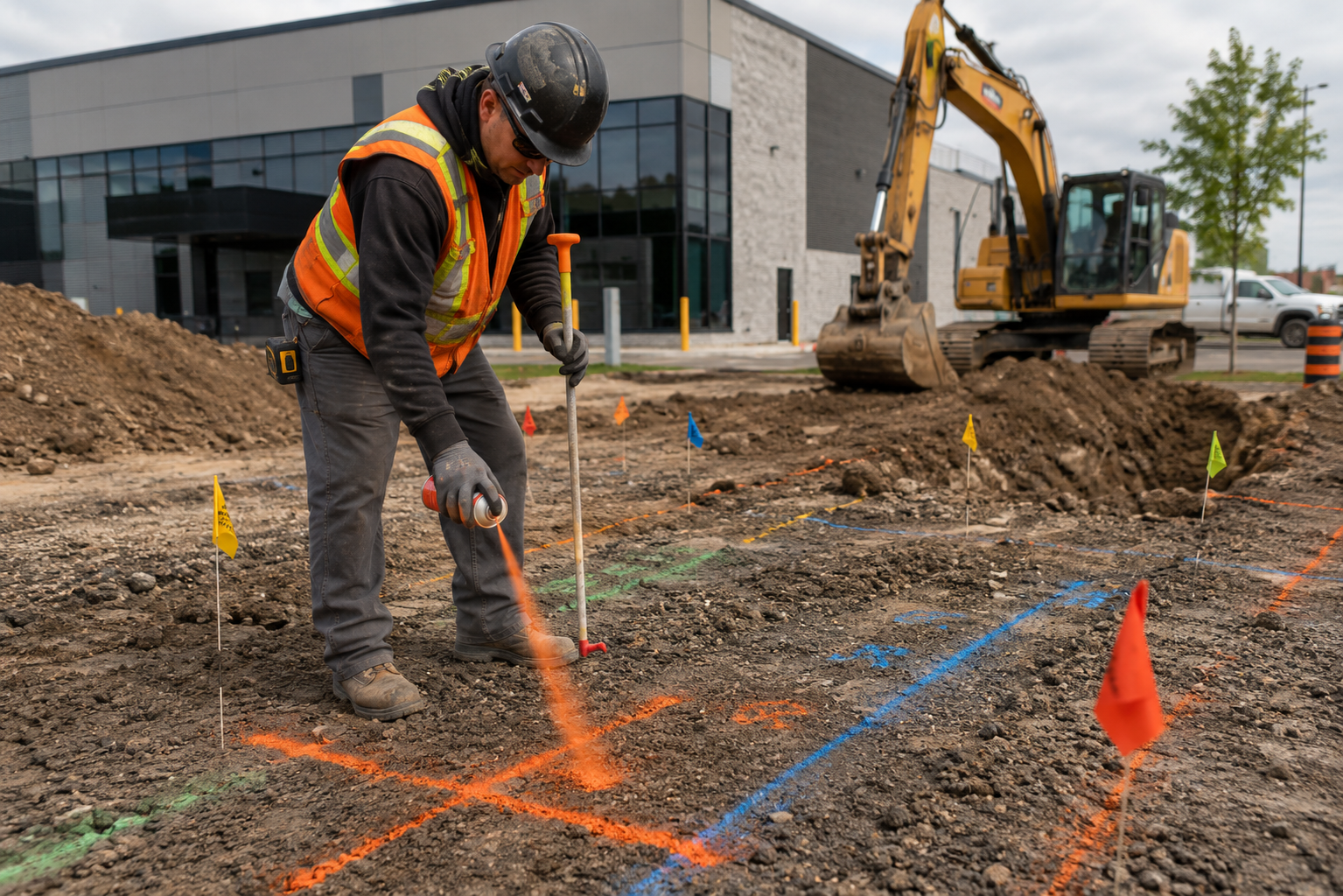
Before any excavation project begins, locating underground infrastructure is one of the most important steps in preventing utility strikes, project delays, and costly repairs. Whether the work involves trenching, directional drilling, grading, site servicing, or foundation excavation, contractors must understand what underground utilities are present before breaking ground.
One area that frequently causes confusion is the difference between public utility locates and private utility locates. While both play an important role in excavation safety, they cover different portions of underground infrastructure. Understanding the distinction can help contractors make informed decisions and avoid unexpected risks on job sites throughout Ontario.
What Public Utility Locates Cover
Public utility locates are typically requested through Ontario One Call before excavation begins. These locates notify participating utility owners that excavation is planned so they can identify and mark the infrastructure they own.
Public utility locates may include:
- Natural gas lines
- Utility-owned electrical services
- Telecommunications infrastructure
- Municipal water services
- Municipal sewer services
When contractors request utility locates, utility owners review the proposed excavation area and mark the location of their buried assets where applicable.
These locates are a critical part of excavation planning and are often required before construction activities can proceed. However, they have an important limitation that many contractors overlook.
Public utility locates only identify infrastructure owned by participating utility companies or municipalities. They do not typically cover utilities that are privately owned after the point of service connection.
This distinction is where many excavation-related utility strikes occur.
What Private Utility Locates Cover
Private utility locates focus on underground infrastructure located on private property that is not owned by public utility providers.
Once utility ownership transfers from the utility company to the property owner, those underground services generally fall outside the scope of Ontario One Call locates. As a result, they may remain completely unmarked unless private locating services are performed.
Private utility locating may identify:
- Private electrical distribution systems
- Parking lot lighting circuits
- Underground communication and data cables
- Irrigation systems
- Private water lines
- Private sanitary and storm services
- Security system cabling
- Building-to-building utility connections
- Underground heating and energy systems
Commercial, industrial, institutional, and multi-residential properties often contain extensive private underground infrastructure that has been added over many years. In many cases, accurate as-built drawings are unavailable or outdated, making private utility locating an essential part of excavation planning.
Private utility locating services help contractors gain a more complete understanding of site conditions before excavation begins.
Where Contractors Commonly Get Confused
The most common misconception is that a completed Ontario One Call locate means all underground utilities have been identified.
In reality, Ontario One Call locates only address participating utility owners and their infrastructure. Once a service enters private property and ownership transfers, that infrastructure may no longer be included in public utility locate markings.
For example, a contractor preparing to excavate near a commercial building may receive markings for municipal water, telecommunications, and hydro infrastructure. However, the property may also contain privately owned electrical feeds, site lighting circuits, communication cables, irrigation lines, or water services that remain unmarked.
Because these private utilities often serve critical building systems, striking one can result in expensive repairs, operational disruptions, and project delays.
The risk increases on older properties where utility installations have occurred over decades without complete documentation.
When underground conditions are uncertain, contractors may also benefit from advanced locating methods such as ground penetrating radar. Ground penetrating radar can assist in identifying subsurface anomalies and buried infrastructure that may not be visible through conventional records alone.
Typical Excavation Projects Requiring Both
Many construction and maintenance projects require both public utility locates and private utility locating services to achieve a complete picture of underground conditions.
Projects that commonly require both include:
Commercial Site Development
New commercial construction often involves extensive excavation for foundations, utilities, parking lots, and landscaping. Existing private services on the property may need to be identified before construction proceeds.
Parking Lot Reconstruction
Parking lot rehabilitation projects frequently require excavation near lighting systems, communication lines, drainage infrastructure, and electrical services that may be privately owned.
Electrical Service Upgrades
Contractors installing new electrical services or modifying existing systems must understand the location of both utility-owned and privately owned electrical infrastructure.
Utility Trenching
Utility trenching projects often cross areas containing a mixture of public and private underground services. Accurate locating helps reduce the risk of accidental damage.
Industrial Facility Expansions
Industrial properties commonly contain extensive underground networks supporting operations, equipment, and building systems. Private utility locating is often a critical component of site planning.
Plumbing and Sewer Repairs
Excavation associated with sewer, water, or drainage repairs may involve both municipal infrastructure and privately owned service connections.
In each of these situations, relying solely on public utility locates can leave contractors exposed to significant risks.
Why Understanding the Difference Matters
Utility strikes can create safety hazards, disrupt operations, increase project costs, and lead to unexpected downtime. Understanding the difference between public utility locates and private utility locates helps contractors identify potential gaps in underground utility information before excavation begins.
A comprehensive locating strategy provides greater visibility into underground conditions and supports safer excavation practices across commercial, industrial, and institutional projects.
Before any excavation activity starts, contractors should evaluate whether both public and private locating services are necessary based on the scope of work and the characteristics of the property.
Request private utility locates before your next excavation project.
For assistance with locating underground infrastructure on private property throughout Ontario, visit the contact us page to speak with a locating professional.
