
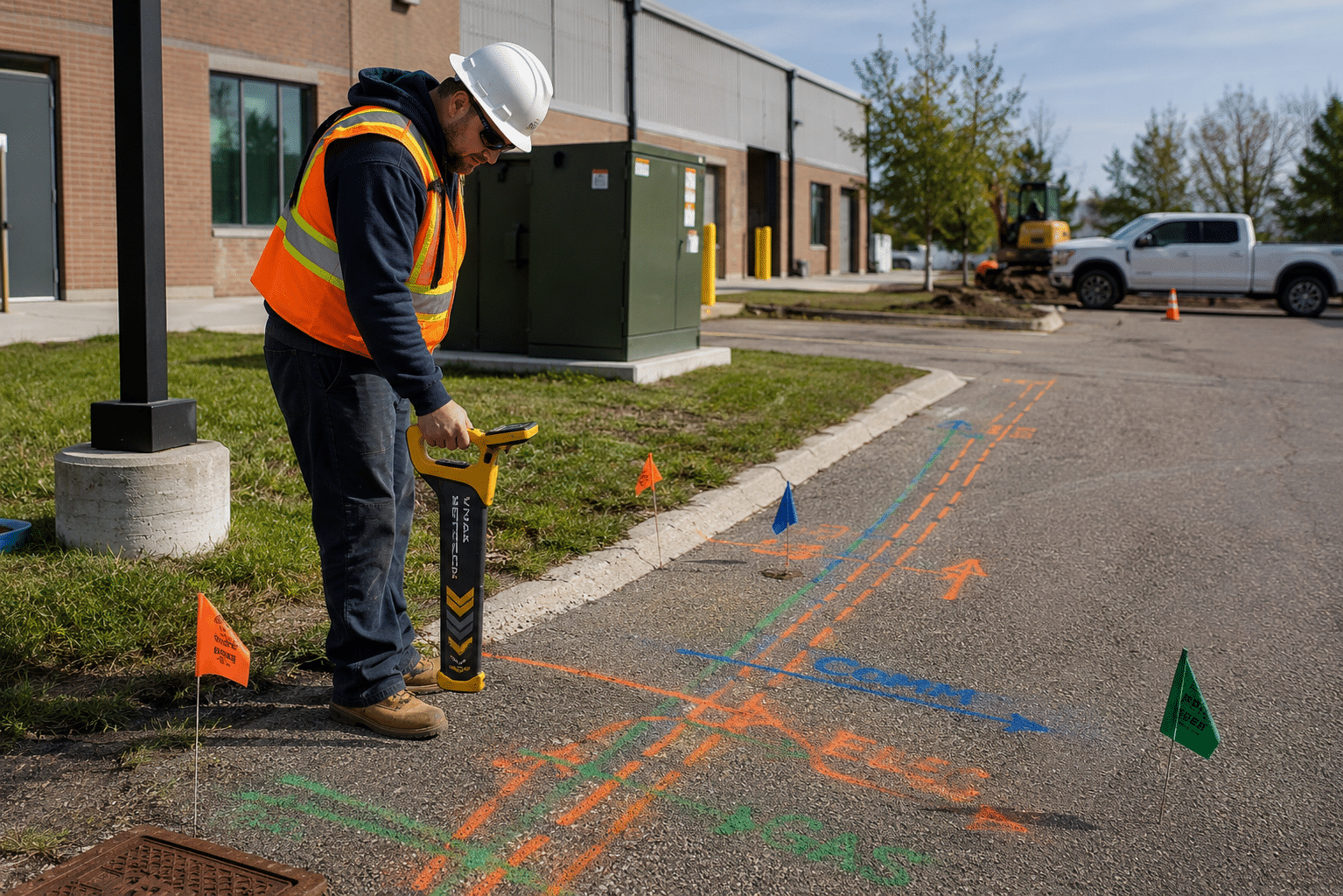
any contractors assume that submitting an Ontario One Call request fully clears a site for excavation. In practice, public locates only identify infrastructure owned by participating utility providers, and that coverage often stops at the property line, meter, or designated service point.
For contractors working on commercial or private property, that leaves a major gap. Buried infrastructure beyond the public ownership boundary may still exist throughout the site, and contractors are responsible for avoiding damage during excavation. That is why private utility locates are frequently required before trenching, drilling, or site servicing begins.
Across Southern Ontario, including Hamilton, London, Kitchener-Waterloo, Cambridge, and Guelph, contractors regularly coordinate both public and private locates to confirm all underground infrastructure before excavation starts.
What Public Locates Actually Cover
Ontario One Call provides locate coordination for publicly owned underground infrastructure. Depending on the property and utility providers involved, this can include:
- Natural gas mains
- Municipal water services
- Public hydro infrastructure
- Telecommunications lines
- Public sewer infrastructure
These locates are essential, but they only apply to infrastructure owned by participating utilities. Once a utility service extends into private property, ownership often changes.
For example, a hydro company may own electrical infrastructure up to a transformer or meter, while the private property owner becomes responsible for buried electrical feeds running across the site. The same applies to many communications lines, irrigation systems, parking lot lighting circuits, and service laterals.
This distinction creates confusion on many excavation projects. Contractors may receive public locates and incorrectly assume the entire site has been cleared for digging. In reality, important underground infrastructure may still remain unidentified.
That is where additional utility locating services become necessary.
Where Private Utility Responsibility Begins
Private utility responsibility usually starts once infrastructure crosses into privately owned property beyond the utility provider’s ownership point.
On commercial and industrial sites, private underground infrastructure can include:
- Electrical feeds between buildings
- Parking lot lighting circuits
- Irrigation systems
- Private communication lines
- Fire suppression lines
- Site servicing infrastructure
- Security gate wiring
- Service laterals
- Underground conduits installed during renovations
These systems are often added during expansions or tenant improvements years after the original site construction. Documentation may be incomplete, outdated, or missing entirely.
For contractors digging on private property, this creates a significant risk during excavation planning.
A trenching crew installing new conduit across a commercial plaza may cross several undocumented private lines before reaching the intended work area. Similarly, contractors performing parking lot excavation may encounter private electrical infrastructure serving lighting poles or detached structures that never appeared on public locate records.
Private utility locates help contractors identify these systems before excavation equipment enters the site.
Common Contractor Situations Requiring Private Utility Locates
There are several excavation scenarios where Ontario One Call alone is usually not enough.
Commercial Building Additions
Commercial additions frequently require excavation for new electrical, plumbing, or communication services. While public locates may identify utility feeds entering the property, they often do not show private infrastructure already running between structures.
A contractor excavating for a building expansion could encounter older buried electrical feeds supplying rooftop equipment, detached units, or previous additions.
Private underground utility locating helps confirm existing site infrastructure before trenching begins.
Electrical Trenching Projects
Electrical contractors regularly trench across private property for service upgrades, transformers, lighting installations, or EV charging infrastructure.
In these situations, contractors may already know where the new installation is planned but still lack visibility into older buried systems crossing the same area. Parking lots and industrial sites are especially common problem areas because underground electrical infrastructure is frequently modified over time.
Private utility locates help reduce the risk of damaging active electrical lines during excavation.
Parking Lot Excavation
Parking lot excavation projects often involve hidden infrastructure beneath asphalt surfaces. Lighting circuits, drainage systems, communication conduits, and abandoned utility lines may all exist below grade.
Because many of these systems are privately owned, they may not appear through Ontario One Call requests.
Contractors planning saw cutting, trenching, or directional drilling through parking lots often schedule private locates as part of pre-dig locating procedures.
Service Upgrades and Site Servicing
Service upgrades on commercial properties commonly involve excavation near existing underground infrastructure. This may include replacing aging electrical services, upgrading communications systems, or extending utilities to new areas of a property.
Older commercial and industrial sites in Hamilton, London, Cambridge, and Kitchener-Waterloo often contain decades of undocumented changes beneath the surface. Excavation planning on these properties requires a more complete understanding of subsurface infrastructure.
Contractors frequently coordinate Hamilton utility locates and London utility locates before excavation to help verify underground conditions across active worksites.
Why Private Lines Are Often Missed
Private underground infrastructure is commonly missed because there is no centralized registry for privately installed systems.
Over time, property owners may add:
- Additional electrical services
- New communication lines
- Outdoor lighting systems
- Detached structures
- Irrigation infrastructure
- Security systems
- Tenant servicing upgrades
These installations are not always recorded accurately, especially on older commercial properties.
In many cases, original site drawings no longer reflect current underground conditions. Contractors may also encounter abandoned lines that remain buried even though they are no longer active.
This creates uncertainty during excavation. Without proper locating, trenching crews may unknowingly damage infrastructure that was never visible on public records.
For sites with uncertain underground conditions, contractors may combine private utility locating with ground penetrating radar services to help identify additional buried infrastructure and subsurface anomalies before excavation begins.
How Contractors Coordinate Private Locates Before Digging
Most contractors treat private utility locates as part of standard excavation planning on commercial or private property.
The process usually begins after Ontario One Call requests are submitted. Once public locates are completed, contractors schedule private locating services to assess infrastructure beyond the public ownership boundary.
Locating technicians use specialized detection equipment to trace underground utility paths, confirm service routes, and mark excavation areas clearly for field crews.
Depending on the project scope, private utility locating may involve:
- Electromagnetic locating
- Signal tracing
- Utility mapping
- Ground penetrating radar
- Site marking and documentation
This process helps contractors coordinate trenching projects more efficiently while reducing the likelihood of excavation delays caused by unexpected underground conflicts.
For excavation contractors, electricians, plumbers, and general contractors, combining public and private locates provides a more complete picture of underground infrastructure before digging starts.
Book private utility locating before your next excavation or trenching project through the Contact Us page.
